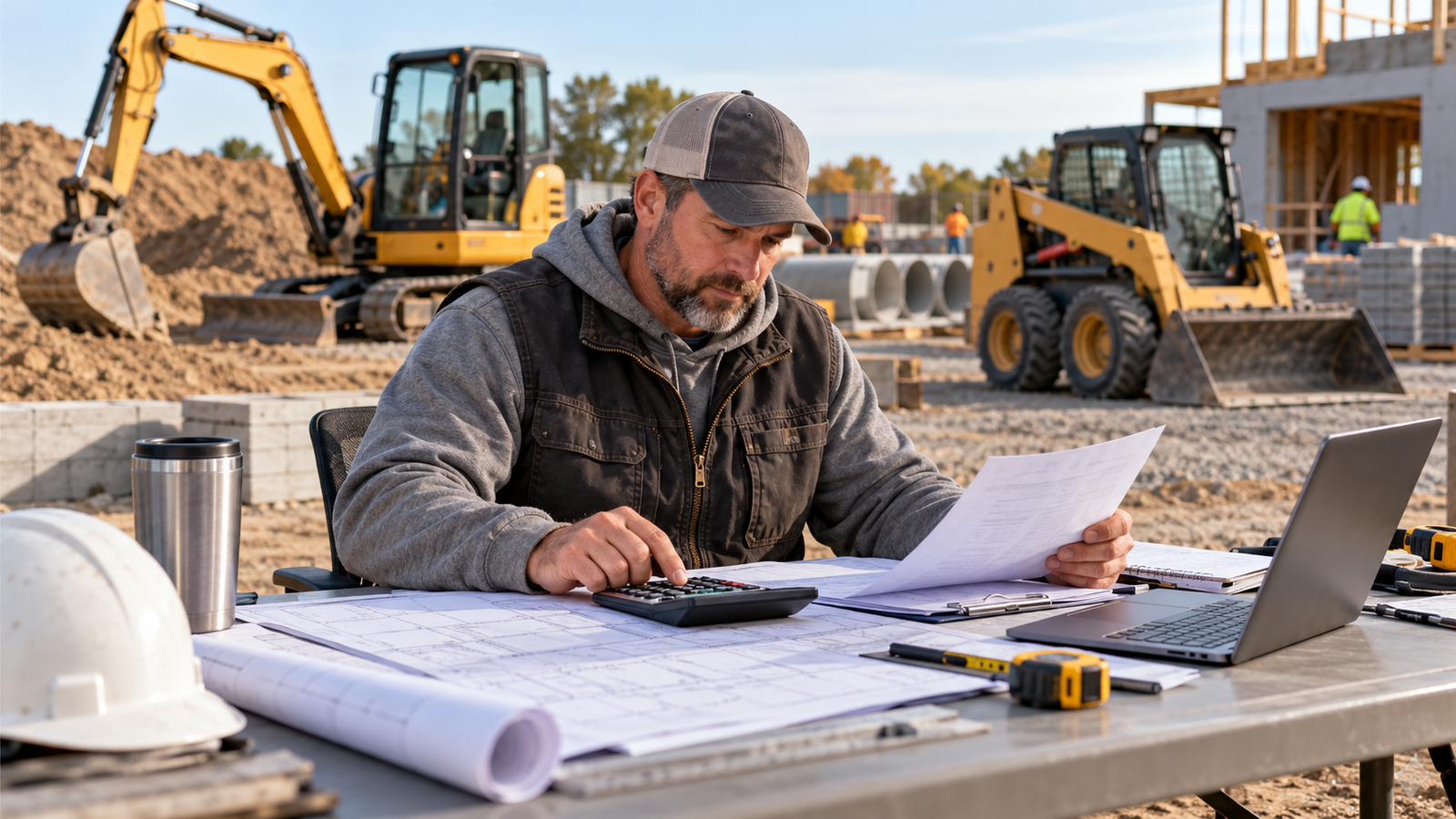
Equipment cost in construction includes much more than the price of renting or buying a machine. Contractors must also account for fuel, maintenance, transportation, setup, operating time, downtime and small tools. If these costs are missing from an estimate, a profitable-looking project can quickly lose money.
This guide explains a practical method for calculating equipment costs before submitting a contractor estimate.
What Is Equipment Cost in Construction?
Equipment cost in construction is the total cost of using machinery, vehicles and tools to complete a project. It may include ownership or rental charges, fuel, maintenance, repairs, transportation, setup, operators, wear items and reasonable downtime.
Why Equipment Costs Belong in a Contractor Estimate
Equipment enables the work to be completed, but every hour or day of use has a cost. Even equipment that a contractor already owns is not free.
Owned machines lose value over time and require insurance, servicing, repairs and storage. Rented machines may involve delivery charges, damage waivers, fuel charges and overtime fees in addition to the advertised rental rate.
Failing to include these expenses can cause several problems:
- The project appears more profitable than it really is.
- The contractor’s overhead is used to cover direct equipment costs.
- Unexpected rental extensions reduce the final margin.
- Equipment-intensive jobs are priced too low.
- Estimated and actual job costs become difficult to compare.
Equipment should therefore be considered while preparing the original contractor job cost estimate, not after the work has started.
Direct Equipment Cost Versus Overhead
Before calculating a cost, determine whether the equipment is being used for one particular project or for the business generally.
A direct equipment cost can be connected to a specific project. Examples include an excavator rented for five days, a concrete mixer used on one site or the fuel consumed by a loader during a particular job.
Equipment overhead supports several projects or the business as a whole. Examples may include workshop equipment, general-purpose office vehicles, equipment storage and tools that cannot be tracked economically to individual jobs.
The treatment should be consistent. Do not charge the same equipment cost directly to a project and again through the company’s overhead recovery calculation.
How to Calculate Equipment Cost in Construction in 8 Steps
1. List the Equipment Required
Start with the scope of work and list every machine, vehicle and major tool required to complete it.
The list might include:
- Excavators
- Loaders
- Skid steers
- Compactors
- Generators
- Concrete mixers
- Scaffolding
- Lifts
- Trucks and trailers
- Pumps
- Saws and other powered tools
For each item, estimate the number of hours, shifts, days or weeks it will be needed. Connect the equipment schedule to the quantities in the project’s material takeoff and work programme.
2. Decide Whether the Equipment Will Be Owned or Rented
The calculation depends on whether the contractor owns the equipment or hires it from a rental company.
For owned equipment, calculate an internal hourly or daily rate that covers ownership and operating expenses.
For rented equipment, obtain a current quotation and identify all charges that may apply. Do not rely only on a rental company’s headline rate.
The decision to rent or use owned equipment should also consider availability, expected utilisation, transportation and the risk of delays.
3. Calculate the Hourly Cost of Owned Equipment
Owned equipment normally has two categories of expense:
Ownership costs
- Depreciation or loss of value
- Financing or interest
- Insurance
- Registration and applicable taxes
- Storage
- Licensing
Operating costs
- Fuel
- Lubricants
- Routine servicing
- Repairs
- Tyres, tracks and wear parts
- Cleaning
- Inspection expenses
A simple estimating formula is:
Hourly ownership cost = Annual ownership costs ÷ Expected annual operating hours
Then calculate:
Hourly equipment cost = Hourly ownership cost + Hourly operating cost
Finally:
Project equipment cost = Hourly equipment cost × Estimated project hours
For example, assume a machine has annual ownership costs of $12,000 and is expected to operate for 1,200 hours during the year.
Hourly ownership cost:
$12,000 ÷ 1,200 = $10 per hour
If fuel, maintenance, repairs and wear items cost an estimated $18 per operating hour, the total internal rate is:
$10 + $18 = $28 per hour
If the project requires 60 equipment hours:
60 × $28 = $1,680
Transportation, setup and the operator’s labour may still need to be added.
Depreciation used for internal estimating is not necessarily the same as depreciation used for accounting or taxation. The IRS Publication 946 explains US tax depreciation rules, but contractors should obtain appropriate accounting advice for their own records.
4. Calculate the Complete Rental Cost
For rented equipment, request a written quotation and check what the quoted price includes.
Possible rental expenses include:
- Hourly, daily, weekly or monthly rental charge
- Delivery to the site
- Collection from the site
- Damage waiver
- Insurance
- Taxes
- Fuel
- Cleaning
- Environmental charges
- Attachments
- Overtime or excess-hour charges
- Late-return charges
Suppose a mini excavator is required for five days:
- Rental: $350 per day × 5 days = $1,750
- Delivery and collection: $300
- Damage waiver: $175
- Estimated fuel: $225
- Cleaning allowance: $50
The total estimated equipment cost is:
$1,750 + $300 + $175 + $225 + $50 = $2,500
Using only the $1,750 rental charge would understate the cost by $750.
5. Add Transportation, Mobilisation and Setup
Equipment must often be transported to the project and prepared before productive work begins.
Include expenses such as:
- Low-loader or trailer charges
- Driver time
- Loading and unloading
- Transport permits
- Fuel used during transport
- Equipment assembly
- Safety inspections
- Testing and calibration
- Removal from the site
If the equipment will serve several projects, use a reasonable and consistent method to divide shared mobilisation costs.
6. Treat Operator Labour Consistently
An equipment rate may include an operator, or the operator’s time may be shown separately under labour.
If a rental company provides an operated machine, confirm whether the quotation includes the operator’s wages, overtime, travel and subsistence.
If one of your employees operates the machine, calculate that person’s labour cost using the same method used for other project workers. The guide on calculating contractor labour cost explains why wages alone do not represent the full cost of labour.
Do not include the operator in the equipment rate and then charge the same hours again under labour.
7. Allow for Utilisation and Reasonable Downtime
A machine may remain on site for eight hours but perform productive work for only six hours. Time may be lost because of material delays, inspections, weather, access problems or coordination with another trade.
This does not mean that every possible delay should be hidden inside an inflated equipment rate. Instead, prepare a realistic work programme and consider:
- Expected productive hours
- Necessary setup time
- Normal refuelling and inspection time
- Standby time that is reasonably foreseeable
- Rental periods that cannot be divided into smaller units
If a machine is needed for part of a day but the supplier charges a full-day rate, the estimate should contain the full-day cost.
A separate contingency allowance may be appropriate for uncertain events, but it should not replace a carefully calculated equipment cost.
8. Total, Review and Transfer the Cost to the Estimate
Add the ownership or rental charge, operating expenses, transport, setup and other project-specific equipment costs.
Review the total against:
- The project scope
- Expected quantities
- Work duration
- Supplier quotations
- Site access
- Labour plan
- Previous project records
Transfer the final cost into the estimate as a clear cost category. Then apply overhead and profit according to the contractor’s normal pricing method.
Remember that markup and margin are not the same. Review markup versus profit margin before converting estimated costs into a selling price.
How to Estimate Small Tools and Consumables
Tracking every drill bit, blade or extension lead individually may take more time than the information is worth. However, excluding small tools completely can also reduce profit.
Contractors can use one of these methods:
Direct Cost Method
Charge identifiable tools and consumables directly to the project. This works well for specialised blades, hired power tools and items purchased specifically for one job.
Standard Allowance Method
Use a standard allowance based on the type and duration of the project. The amount should come from previous job-cost records rather than guesswork.
Percentage Method
Apply a small-tools percentage to an appropriate cost base, such as direct labour. Use this method only when historical records demonstrate that the percentage reasonably represents actual consumption.
Avoid using the same percentage for every kind of project. A repair job requiring many cutting and drilling tools may have a different cost pattern from a simple installation.
Should Equipment Be Shown Separately to the Client?
The presentation depends on the contract and the level of detail appropriate for the client.
Equipment may be:
- Shown as a separate line in the estimate
- Included within a particular work activity
- Combined with labour and materials under a lump-sum item
- Listed as an allowance when the exact requirement is uncertain
The internal calculation should remain detailed even when the client receives a simplified price. A professional estimate must be easy to understand without revealing every internal business calculation.
See how to prepare a professional contractor estimate for guidance on presenting the final price clearly.
Common Equipment-Costing Mistakes
Treating Owned Equipment as Free
Ownership eliminates the rental invoice, but it does not eliminate depreciation, insurance, maintenance, repairs and storage.
Using Only the Advertised Rental Rate
Delivery, collection, fuel, attachments and damage waivers can materially increase the final bill.
Forgetting Mobilisation
Heavy equipment may require specialised transport, permits and loading time.
Double-Counting the Operator
This happens when operator wages are included in an equipment rate and repeated under direct labour.
Ignoring Minimum Rental Periods
A two-hour task may still require a full-day rental.
Using Unrealistic Productive Hours
Assuming that every site hour is productive can understate the required rental period.
Applying an Arbitrary Small-Tools Percentage
Percentages should be supported by past results and adjusted when the type of work changes.
Failing to Update Supplier Prices
Rental, fuel, transport and repair costs change. Use current information whenever possible.
Compare Estimated and Actual Equipment Costs
After completing the project, compare the estimated cost with the actual result.
Record:
- Actual operating hours
- Actual rental period
- Fuel used
- Delivery and collection charges
- Maintenance and repairs
- Downtime
- Operator hours
- Small-tool expenditure
Investigate important differences. Perhaps the machine was underutilised, the rental period was extended or fuel consumption was underestimated.
This comparison improves future equipment rates and helps the contractor track actual job costs and forecast profit.
Frequently Asked Questions
Is fuel included in equipment cost?
Yes. Fuel is normally an operating cost and should be included when the contractor is responsible for supplying it. Confirm whether rented equipment must be returned with a full tank.
Should equipment cost include the operator?
It may include the operator, but the treatment must be consistent. If operator labour is included in the equipment rate, do not charge it again under labour.
How do I charge for equipment I already own?
Calculate an internal hourly or daily rate covering ownership and operating costs. Multiply that rate by the expected project usage and add mobilisation or setup costs where applicable.
Is equipment a direct cost or overhead?
Equipment used specifically for one project is generally treated as a direct cost. Equipment supporting several projects or the business generally may be included in overhead. Use a consistent classification and avoid double-counting.
Should I add profit to equipment costs?
Equipment is part of the contractor’s estimated cost. After calculating all project costs, apply overhead and profit using the company’s established pricing method.
What if the equipment requirement is uncertain?
State an allowance or assumption clearly and explain how additional usage will be handled. The difference between an estimate and a binding quotation should also be understood before presenting the price. See estimate versus quote for contractors for further guidance.
Final Equipment Cost Checklist
Before submitting the estimate, confirm that you have:
- Listed every major machine and tool
- Estimated realistic usage periods
- Selected owned or rented equipment
- Included ownership and operating costs
- Checked complete rental charges
- Added fuel and wear items
- Included delivery and collection
- Allowed for setup and mobilisation
- Treated operator labour consistently
- Considered minimum rental periods
- Included small tools where appropriate
- Applied overhead and profit only after calculating the cost
- Recorded assumptions for uncertain items
Conclusion
Accurate equipment costing protects a contractor from quietly losing profit on machinery, vehicles and tools. The calculation should reflect the complete cost of making equipment available and operating it—not merely the advertised rental price or fuel expense.
A consistent process also makes it easier to compare projects, update estimating rates and identify where actual costs differ from the original plan.
The AZELIVO Contractor Bid-to-Profit Toolkit helps contractors organise labour, materials, equipment, overhead, pricing and actual job costs through one connected estimating workflow.